Table of Contents
- Understanding Agile Organization Design
- Key Benefits of Agile Structures
- Implementing Agile Principles in Your Organization
- Real-World Examples of Agile Success
- Overcoming Challenges in Agile Transformation
- Measuring the Impact of Agility
- Conclusion
As rapid market shifts and technological advances redefine the competitive landscape, businesses are under growing pressure to adapt quickly. It has become increasingly clear that traditional, rigid hierarchies often limit an organization’s ability to respond with the speed the market demands. This is why agile organization design is emerging as a winning approach. By emphasizing flexibility, collaborative structures, and swift decision-making, agile design helps companies stay resilient and innovative. Seeking expert guidance from an organizational design consultant can provide invaluable support for organizations navigating this transformation.
The principles of agility are centered on decentralized authority, empowered cross-functional teams, and rapid feedback cycles. These elements collectively enable organizations to tackle challenges faster and adapt to evolving customer needs, thereby helping pave the way for sustained growth and competitive advantage.
Moreover, agile organization design is not just about structure but also about fostering a culture of continuous improvement. When organizations value learning and adaptability at every level, they are better prepared to seize new opportunities and mitigate risks before they escalate. Embracing agility is no longer an option for true innovators; it’s a necessity in today’s volatile business landscape.
Agility also requires an intentional strategy for embedding these principles into the company’s DNA. Change must be championed consistently by leadership and reinforced through practical steps that empower teams and encourage transparency across all levels.
Understanding Agile Organization Design
Agile organization design is a modern approach to organizational structure that prioritizes adaptability and empowerment. Unlike classic hierarchical models where communication and decision-making flow downward through layers of management, agile organizations function as dynamic networks of cross-functional teams. These teams are given the authority to make decisions quickly, collaboratively solve problems, and pivot based on customer feedback or market changes.
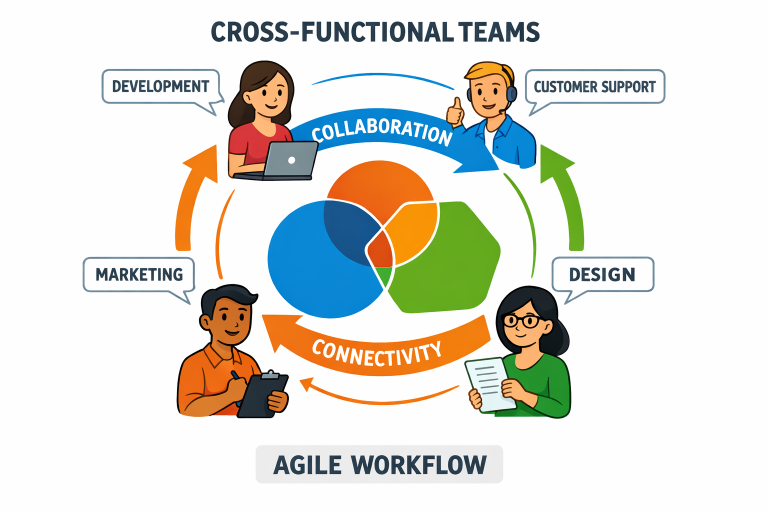
Instead of being confined by silos, agile organizations are designed to break down barriers, fostering knowledge sharing and rapid iteration. The result is not only improved responsiveness but also a deeper alignment with evolving business goals.
Key Benefits of Agile Structures
Agile structures have been shown to deliver a range of tangible business advantages that drive excellence in both performance and culture.
- Enhanced Flexibility:Agile organizations can shift direction rapidly, responding to external and internal changes without significant disruption.
- Improved Employee Engagement:Team empowerment fosters higher motivation and a sense of ownership, leading to better retention and job satisfaction.
- Faster Time-to-Market:Streamlined processes eliminate bottlenecks, allowing for the accelerated launch of products and services.
- Increased Customer Satisfaction:Through continuous customer feedback loops, teams can deliver offerings that are closely aligned with customer expectations, boosting loyalty.
Implementing Agile Principles in Your Organization
Adopting agile organization design requires deliberate, systematic action. Here are the essential steps for a successful transformation:
- Leadership Commitment:A genuine, ongoing commitment from senior leaders is crucial. Leaders set the tone for openness to change and encourage buy-in throughout the organization.
- Training and Development:Offer focused training so employees at all levels are equipped with agile methodologies and mindsets. This can include workshops, coaching, and ongoing development programs.
- Restructuring Teams:Build autonomous, cross-functional teams composed of members from various departments who can make decisions and deliver independently.
- Continuous Improvement:Develop a culture where learning and adaptation are continuous. Encourage feedback at every stage and be ready to make iterative changes as new insights are gathered.
Real-World Examples of Agile Success
Organizations of varying sizes and sectors are embracing agile design to meet business objectives. A great example is a European bank that developed an in-house agile academy. This academy trained around 100 agile coaches and rolled out specialized development programs for different roles in the company. Over 20,000 employees completed these programs, which played a significant part in speeding up the overall transformation and creating a robust, supportive agile community within the bank. The outcome was noticeably faster innovation cycles and increased engagement throughout the organization. For a broader industry view, McKinsey highlights similar transformation stories in their thought leadership pieces.
Overcoming Challenges in Agile Transformation
Transitioning to agility is no small feat, and several challenges commonly arise:
- Resistance to Change:Employees accustomed to fixed roles and familiar routines may initially resist agile practices. Communication and training are essential for smoothing this path.
- Maintaining Alignment:As teams become more independent, staying aligned with the organization’s broader goals can become complex. Clear objectives, regular check-ins, and transparent communication channels help maintain unity.
- Scaling Agile Practices:Implementing agile across a large or global organization requires thoughtful scaling strategies, standardized tools, and patience to realize the full benefits.
Measuring the Impact of Agility
To ensure the investment in agile organization design delivers tangible value, leaders must consistently measure progress using key performance indicators:
- Time-to-Market:Regularly track the length of time from initial conception to commercial launch of products to gauge improvements in responsiveness.
- Employee Engagement Scores:Monitor surveys and qualitative feedback to assess improvements in morale, retention, and motivation.
- Customer Satisfaction Ratings:Leverage net promoter scores and customer feedback platforms to discern trends in customer experience.
- Financial Performance:Analyze top-line growth, profitability, and operational efficiency metrics for holistic insight.
Conclusion
Agile organization design is quickly becoming a foundational driver of modern business success. By prioritizing flexibility, empowering people, breaking down silos, and continuously iterating on practices, companies equip themselves with the tools to outpace competitors. Agile is not merely a trend but a strategic imperative for those seeking excellence and innovation in a fast-changing world.
Related Posts

Amazon Is Quietly Rebuilding Its Hiring Process With AI—And It Affects More Than Engineers
There's a shift happening inside Amazon's recruitment pipeline that most…
Thehrwp: Smart Workflow Automation & Future of Human Resource Management
The concept of thehrwp is gaining attention as organizations increasingly…